
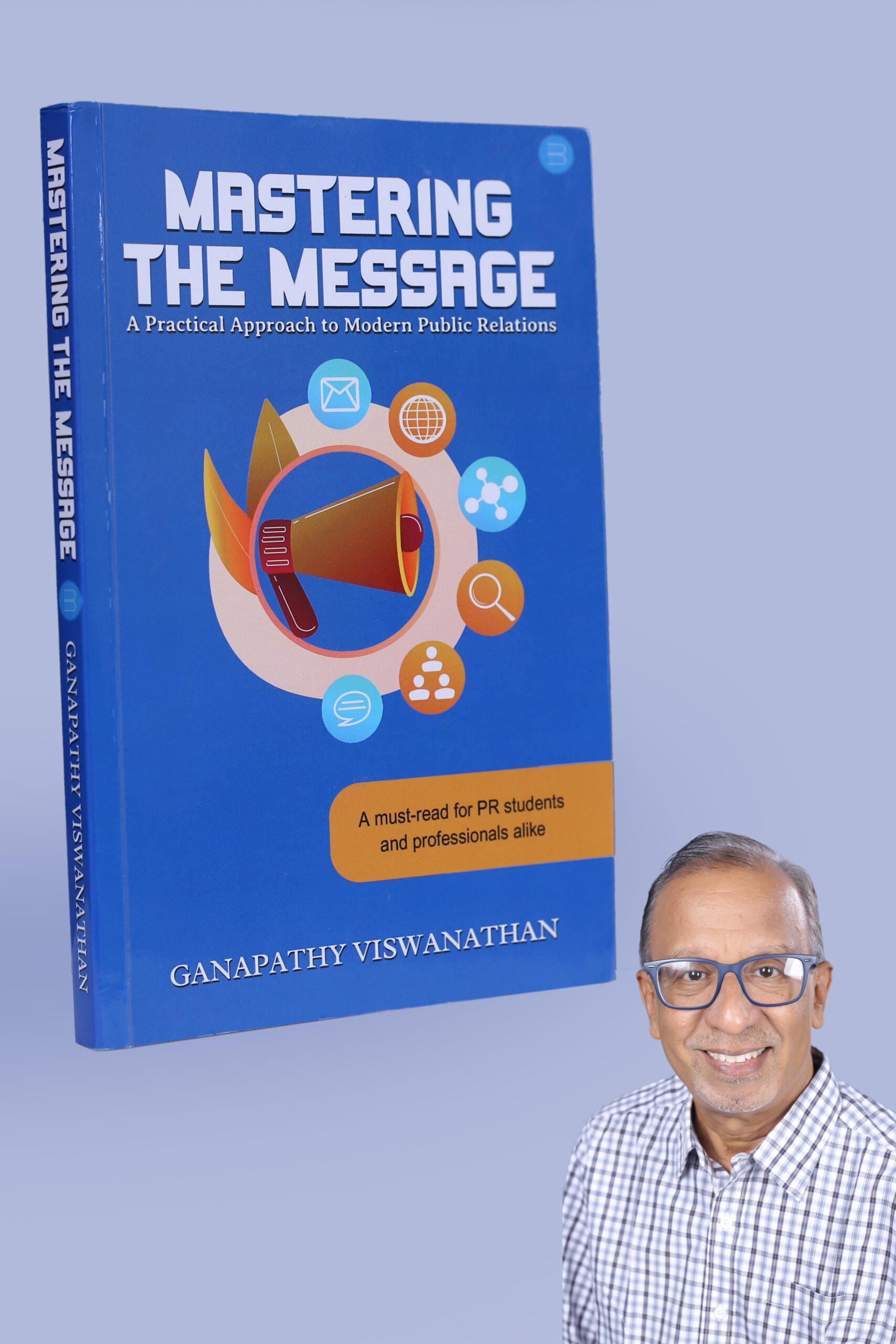
I’ve known Ganapathy for decades – right from my first job at Ogilvy, so hearing that he had published a book on PR obviously peaked my interest. But even before I could say Public, I found that most people had swooped in and done reviews of the book. I decided that the world did not need one more review, I’d rather do an interview! So here it is. Some questions posed to Ganapathy. Some that he chose to answer. And some insights on the book just published:
Mastering the Message: A Practical Approach to Modern Public Relations.
Read it and gain insights. And yes there’s a link at the end of the interview if you want to buy the book!
ME: You have over 30 years of experience in advertising and PR (Ogilvy, Lintas, Mudra, Publicis). How did your journey in PR begin, and which experiences early on shaped your thinking about what PR really is?
V. Ganapathy: Advertising was always my first exposure in the business of communication. I began to understand the value of PR in the early 80s; those were the early days of PR in India. A very close relative, who was deeply involved in the field, frequently highlighted its importance during our meetings when PR was taking shape in India.
Later, while working in the Financial and Business Communication Division at Ogilvy, I gained more hands-on experience with PR, while organizing press and broker conferences for clients like Punjab Breweries, McDowell’s, and Titan during the IPO boom. These events helped me learn and absorb the fundamentals of public relations.
My most in-depth exposure, however, came when I joined the full-fledged PR consulting firm 2020 MSL (part of the Publicis Group). At MSL, I learned how the business of PR actually works: from strategy to building narratives, understanding media intelligence, stakeholder mapping, content creation, and integrated campaign execution. I saw how reputation is built through a combination of insight, consistency, and operational rigor, and how every campaign must align with business goals, not just communication outputs. That experience gave me a true end-to-end understanding of PR as a vertical, and it shaped the consultative mindset I carry even today.
ME: Great. Coming to the book. Your book traces the evolution of PR in India over nearly 50 years. What, in your view, have been the most significant turning points?
V. Ganapathy: I believe the importance of PR in India truly accelerated when the first World PR Congress was held in Mumbai. The father of Public Relations, Sam Black, was one of the keynote speakers, along with several other global and Indian leaders from the communications world. After this Congress, the significance of PR gained strong momentum in our country.

One of the most significant shifts happened during the IPO boom. As companies prepared to go public, the need to build a corporate image and strengthen investor relations became a top priority and PR emerged as a crucial tool to achieve this. This momentum continued until the Indian economy opened up in 1992. As multinationals entered the Indian market, they brought with them a deep understanding on the importance of PR for using it strategically to establish and communicate their strong presence in India.
The advent of social media also provided a new dimension to PR. In the last 10 years, the growth of PR has been rapid, with the use of AI and ML. This led to more innovation which helped PR agencies to dwell more into research and cull out sharper insights with more precise messaging. These tools now also help to target communication more effectively to the right audiences.
ME: Over the years, you have been a prolific writer, but what propelled you to bring out a book? This book?
V. Ganapathy: My interest and passion for writing began almost two decades ago when one of my articles got published in a leading business daily in the South. That initial success reinforced my inclination to write, and I continued contributing to select trade journals. Later, when I joined the editorial board of a prominent marketing and advertising publication, I introduced PR as a vertical and began writing a dedicated column related to PR and brand communication.
We also organized an annual PR conclave, which attracted significant interest and further deepened my involvement in the field. The PR conclave is still happening regularly every year. Having written so many stories on PR over the years, I felt the time was right to compile them into a book that was primarily targeted at aspiring PR students looking to build a career in the industry. I believe that presenting these experiences and insights in a book form will help the student community to understand better and learn more about PR.
ME: In the book, you stress the importance of storytelling. What makes a story truly effective in today’s media environment?
A. Storytelling isn’t new. As children, many of us grew up listening to our grandparents’ stories to simple, authentic narratives that stayed with us. The same principle applies today. In a hyper-cluttered media environment, only stories that feel real and emotionally engaging can cut through the noise.

With audiences constantly bombarded by content across digital platforms, social media, and traditional channels and with attention spans shrinking, a story must connect instantly. That’s why the most effective narratives are simple, relatable, and grounded in real human experiences rather than heavy jargons.
Credibility is equally crucial. In an era of rising misinformation and fake news people gravitate toward stories rooted in facts, transparency, and purpose. Visual storytelling also plays a major role: compelling images, videos, and data-driven formats help messages land faster and stay memorable.
Ultimately, an effective story is one that not only captures attention but also builds trust and inspires action. In PR, when a narrative aligns with a brand’s values and genuinely offers something meaningful to the audience, it becomes both powerful and enduring.
ME: Crisis communication has become more complex in the digital age. What distinguishes an effective crisis response from a damaging one?

V. Ganapathy: In today’s social-media-driven world, crisis management has become far more complex and demanding. With information spreading at lightning speed and companies vulnerable to backlash round the clock, even for minor mistakes—organizations must navigate crises cautiously. In this digital environment, effective crisis communication depends on speed, transparency, empathy, and consistency in your messaging.
An effective crisis response in the digital age is distinguished by speed, transparency, and genuine empathy. Because information spreads instantly on social media, organizations must acknowledge issues quickly, share verified facts, and communicate with a human tone. Consistent messaging across platforms and clear explanations of corrective actions help maintain credibility and reassure the public. A damaging response, on the other hand, is typically slow, defensive, or evasive, which creates space for misinformation to spread and erodes trust. Ultimately, what sets an effective crisis response apart is the organization’s ability to act swiftly, communicate openly, and demonstrate real accountability.
ME: You mention a ‘talent gap’ in the PR industry. What skills do you feel future professionals absolutely need to succeed?
V Ganapathy: The PR industry is facing a talent gap mainly because the rules of the game keep changing. Fresh graduates from communication schools often enter agencies without enough practical exposure, which means firms have to spend extra time training them. Longer, more hands-on internships in colleges would make a big difference, and while a few institutions are taking this seriously, it needs to become a wider practice and part of the curriculum.
The growing importance of digital has widened this gap even more. Agencies are struggling to find people who understand digital platforms, content formats, and the fast-moving nature of online communication.
In terms of knowledge and skills, future PR professionals will need strong writing and storytelling abilities, comfort with digital and social media, basic understanding of analytics, content creation skills, and the ability to think strategically and adapt quickly. Strengthening these areas—along with better real-world training—will be key to meeting the industry’s evolving expectations.
Want to buy the book? Here’s the LINK
ME: It’s been some time since the book is released. Who do you think has appreciated it the most?
V. Ganapathy: Since the book’s release, I’ve been encouraged by the positive feedback from both PR professionals and students. Many have appreciated its simplicity and the fact that I’ve intentionally avoided complicated jargons, making it easier for beginners to grasp. A leading online magazine praised its practical orientation and some insights were even referenced at a recent PR symposium by a senior PR professional. I’ve also received advance appreciation from senior business leaders across marketing, PR, and advertising, who believe the book will serve as a strong starting point for beginners entering the field.
ME: I’ve seen you with students of possibly communications and media. What would your message be to them in context of this book?
V. Ganapathy: My message to students of communication and media, in the context of this book, is simple: treat PR as a profession that thrives on continuous learning. The field is constantly evolving and to stay relevant you must be adaptable, agile and grounded. Use this book as both a refresher and a foundation—but don’t stop there. Ultimately you need to upgrade yourself with continuous reading and learning.
PR is a knowledge-driven discipline. Read widely, stay curious about the economic and business world, and make the effort to understand your clients’ business deeply. Strong writing and clear presentation skills remain at the core of effective PR and the value you bring to your clients will always depend on the insights, solutions, and perspective you offer.
If you commit to learning, stay curious, and focus on adding real value, you will grow into a good PR professional that clients trust and respect.
V. Ganapathy, Author, Mastering the Message
